
Intel 11th-gen Core i7-1185G7 Tiger Lake Preview: It’s (mostly) faster than Ryzen
It wouldn’t be a stretch to say that Intel’s 11th-gen Tiger Lake is maybe a very powerful laptop computer CPU launch for the corporate. Whereas earlier generations suffered no actual competitors from AMD, Tiger Lake enters the ring dealing with a official foe: Ryzen 4000.
You’ll be able to learn up on AMD’s game-changing Ryzen 9 4800HS, or its lately surfaced and equally spectacular Ryzen 7 4800U for mainstream laptops. And sure, that was a funds Acer beating a Core i7 MacBook mindless.
As we speak, nonetheless, is about whether or not Intel’s new 11th-gen 10nm Tiger Lake chip and its SuperFin transistors and Iris Xe graphics have what it takes to maintain AMD at bay. Intel gave us the chance to take an 11th-gen Tiger Lake reference laptop computer (a pattern design, not a retail product) for a spin.
Hold studying to see the way it fares in a grueling roster of benchmarks. And if you wish to skip to a particular part, please use the hyperlinks at left or under:
 Gordon Mah Ung
Intel gave us full entry to a reference laptop computer with an Intel 11th gen Core i7-1185G7 inside it.
A preview with situations
For this efficiency preview, Intel loaned us the laptop computer with a number of strings hooked up. We are saying few, as a result of there have been a pair extra for which we had a nerds’ settlement to not check.
The principle one was battery life. Intel stated the reference laptop computer was nonetheless fairly tough in tuning, and the corporate didn’t suppose it will be consultant of battery life from a ultimate unit. The trickle-down of that meant we additionally couldn’t report on, say, how a lot energy it used whereas on battery. Though battery energy is extraordinarily essential in a laptop computer, we felt it was a good request.
The second request was to not present a photograph of the insides of the laptop computer. We’re allowed to indicate you the underside of it, and since we’ve seen the within, we’ll sketch out the place the elements are.
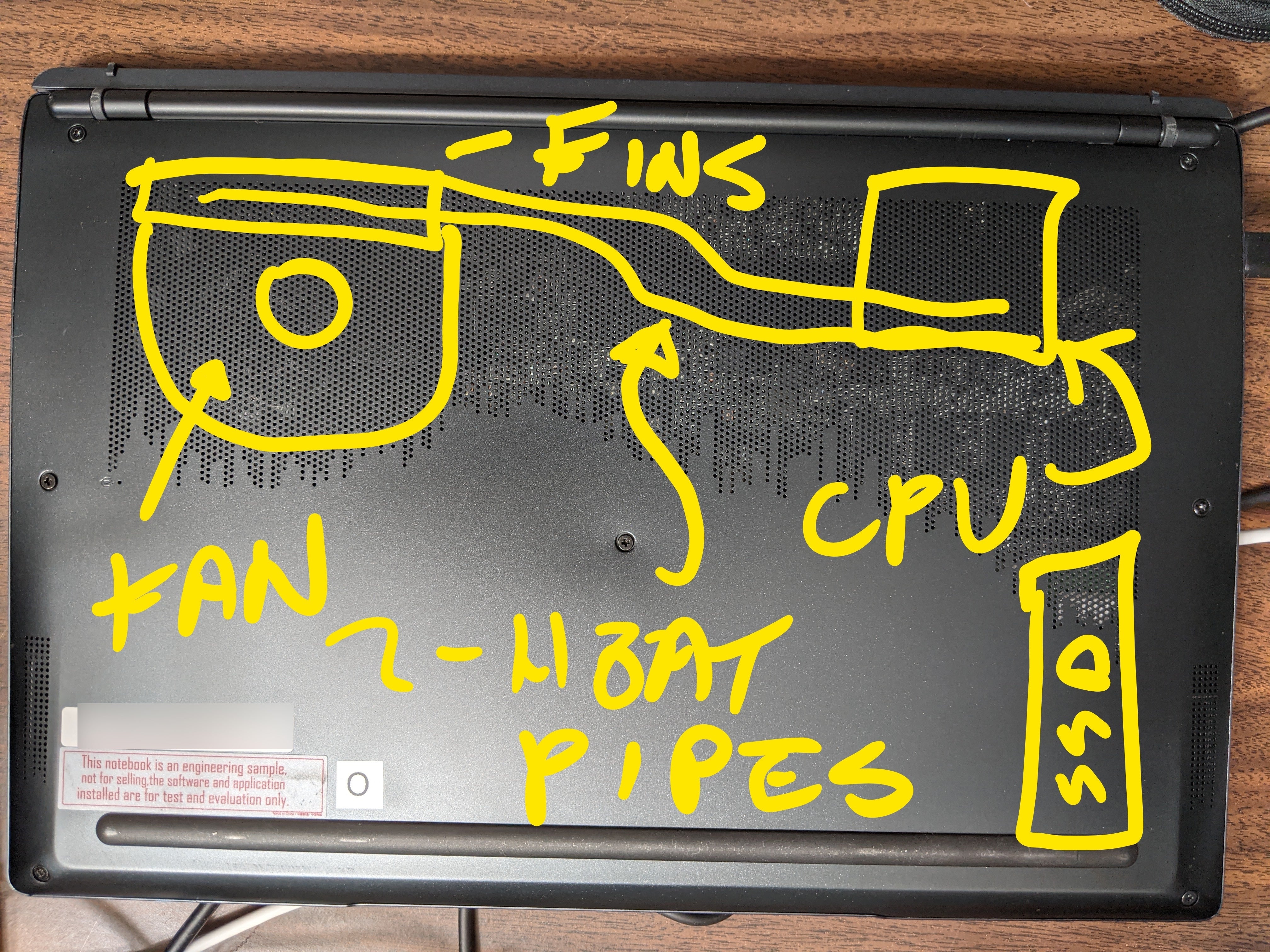 Gordon Mah Ung
The Intel Tiger Lake reference laptop computer we used featured two warmth pipes and a single fan and fin stack.
The laptop computer itself is constructed on a reasonably gentle 14-inch physique. In weight, it’s truly very near the 10th-gen Dell XPS 13 2-in-1 7390 and barely lighter than Lenovo’s 14-inch, Ryzen 7-based Slim 7. The laptop computer is definitely able to taking discrete graphics and options two warmth pipes routed to a single fan and fin stack. The laptop computer incorporates a Core i7-1185G7 Tiger Lake CPU with 16GB of LPDDR4X/4266 RAM and a 1TB NVMe SSD. There display screen is a 1920×1080 panel with out contact.
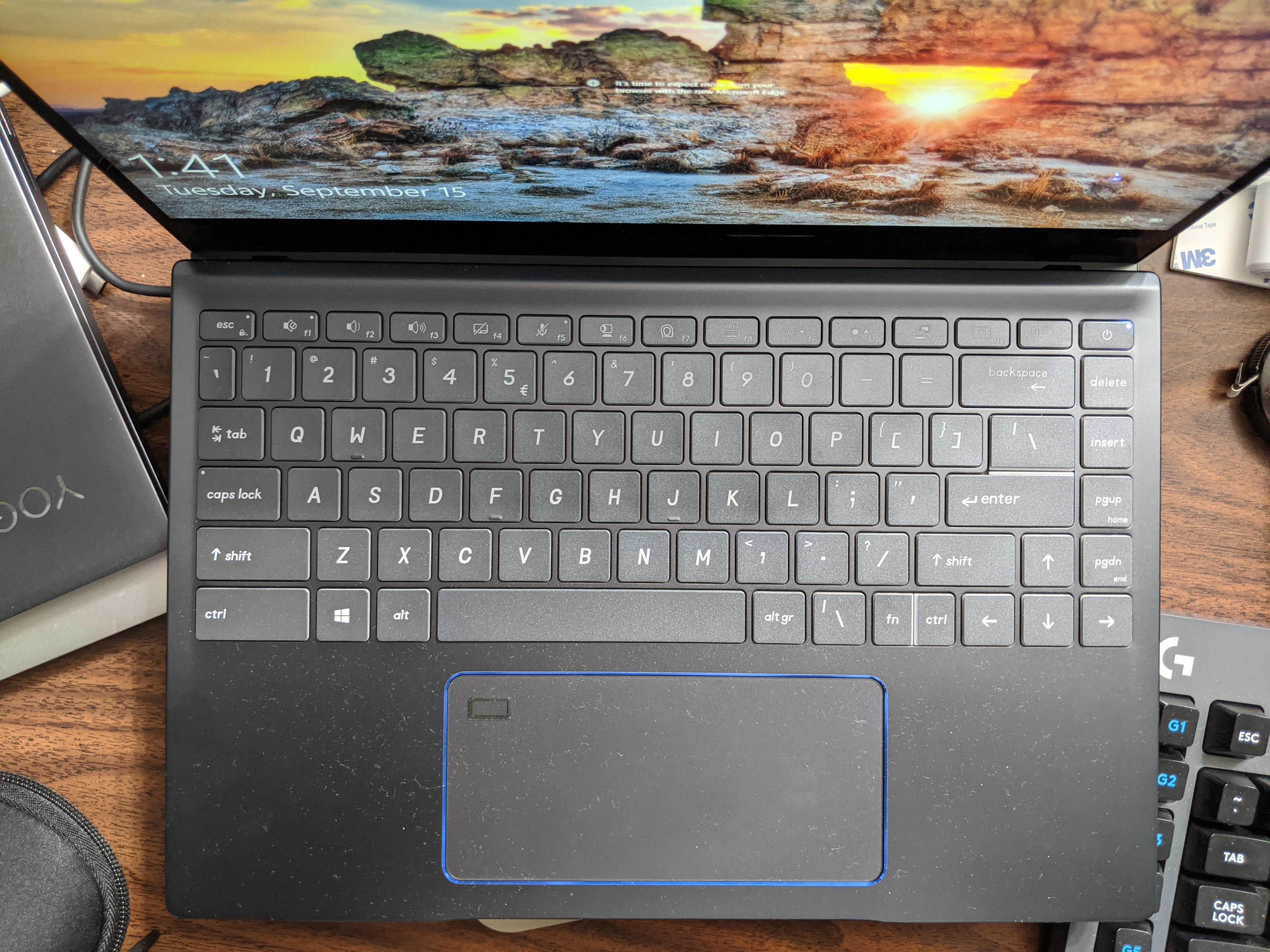
We will guess who made it, however we’ll persist with our settlement and seek advice from it as a reference system. It’s fairly straightforward, nonetheless, to seek for 14-inch laptops with Comet Lake U and discrete GeForce GTX graphics if you wish to see it in its branded trim.
Apart from these agreements, we had been free to run what we wished. Intel did present its RUGs, or “Consultant Utilization Guides,” that are canned assessments constructed on sensible purposes.
Whereas we predict there’s worth in them, we skipped operating Intel’s personal assessments, as a result of it invitations an excessive amount of hand-wringing from worrywarts. That doesn’t imply we skipped what Intel examined although, which you’ll see under.
 Gordon Mah Ung
The Intel reference laptop computer does characteristic an Intel emblem on the lid.
How we examined
For this efficiency preview, we in contrast the Core i7-1185G7 and Iris Xe graphics to 3 contemporaries: “Comet Lake U” in a Dell XPS 13 7390 with 6-core Core i7-10710U and HD graphics, “Ice Lake” in a Dell XPS 13 2-in-1 7390 with Four-core Core i7-1065G7 and Iris Plus graphics, and a “Renoir” Eight-core Ryzen 7 4800U in a Lenovo Slim 7 with Radeon graphics. All the laptops had been operating up to date show drivers, the most recent UEFI/BIOSes, and Home windows 10 2004.
All three had been additionally run on their highest efficiency settings. For the Dells that’s “Extremely Efficiency,” and for the Lenovo that’s “Excessive Efficiency.” Taking a look at what the laptops reported, the 14nm Comet Lake U informed HWInfo it had a PL1 energy restrict of 22 watts. You’ll be able to consider energy limits just like the gears of a automotive, and PL1 may be very very similar to a second or third gear. A laptop computer will first hit PL2 for only a few milliseconds after which maybe push PL1 for 28 seconds, or so long as it could actually maintain a sure thermal and energy threshold. The XPS 13 7390’s 6-core CPU exhibits the weak point of the new 14nm chip with its 22-watt PL1. The 10nm 10th-gen Ice Lake within the XPS 13 2-in-1 7390 says it could actually hit 46 watts in PL1 for 28 seconds. We truly don’t suppose it’s 46 watts—we suspect HWInfo is studying the laptop computer’s Adaptix expertise. Adaptix makes use of machine studying to attempt to maintain larger increase clocks. For the Lenovo Slim 7, HWInfo reported a PL1 of 38.5 watts.
All the TDP rankings of retail laptops are based mostly on tuning and optimization by the OEM. For the reference laptop computer, Intel lets us decide from three TDPs utilizing the Home windows energy slider: 15 watts, 28 watts, and 28 watts with Dynamic Tuning. Dynamic Tuning is a part of Intel’s suite of instruments to coax larger clock speeds out of a chip based mostly on the workload. For what it’s price, HWInfo recognized this as a PL1 of 36 watts. The final knob we had accessible to us was the laptop computer’s personal Excessive Efficiency setting, which, when set, raised the PL1 to 41 watts.
 Gordon Mah Ung
Can you determine who constructed Intel’s reference laptop computer?
The restrictions of this preview
Whereas this preview will present what a Tiger Lake is able to, there are limits to it. That’s as a result of PC OEM usually tune laptops based mostly on what they wrap across the CPU. Whereas we will present you the way it performs at a hard-locked 15 watts (28 watts with Dynamic Tuning enabled), it’s exhausting to say what a selected laptop computer maker will determine for its design. Briefly, your mileage might fluctuate in an precise manufacturing laptop computer.
Nonetheless, the worth is you’ll be able to doubtlessly see the higher and decrease limits of how properly an 11th-gen Tiger Lake performs. In a design that pushes Tiger Lake exhausting, reminiscent of MSI’s Stealth 15M, it’d even be sooner.
11th-gen graphics efficiency: Intel in entrance!?
We’ll kick this off within the space that’s really essentially the most surprising: Intel’s main graphics efficiency. And sure, in the event you see a snowman in summer season, it’s as a result of for the first time in forever, Intel’s graphics efficiency is not embarrassing.
UL’s 3DMark Sky Diver is an artificial, however very repeatable graphics check that’s made to measure pretty average gaming hundreds. We’ll first present you 3DMark’s Sky Diver graphics outcome, which makes it a virtually pure graphics check.
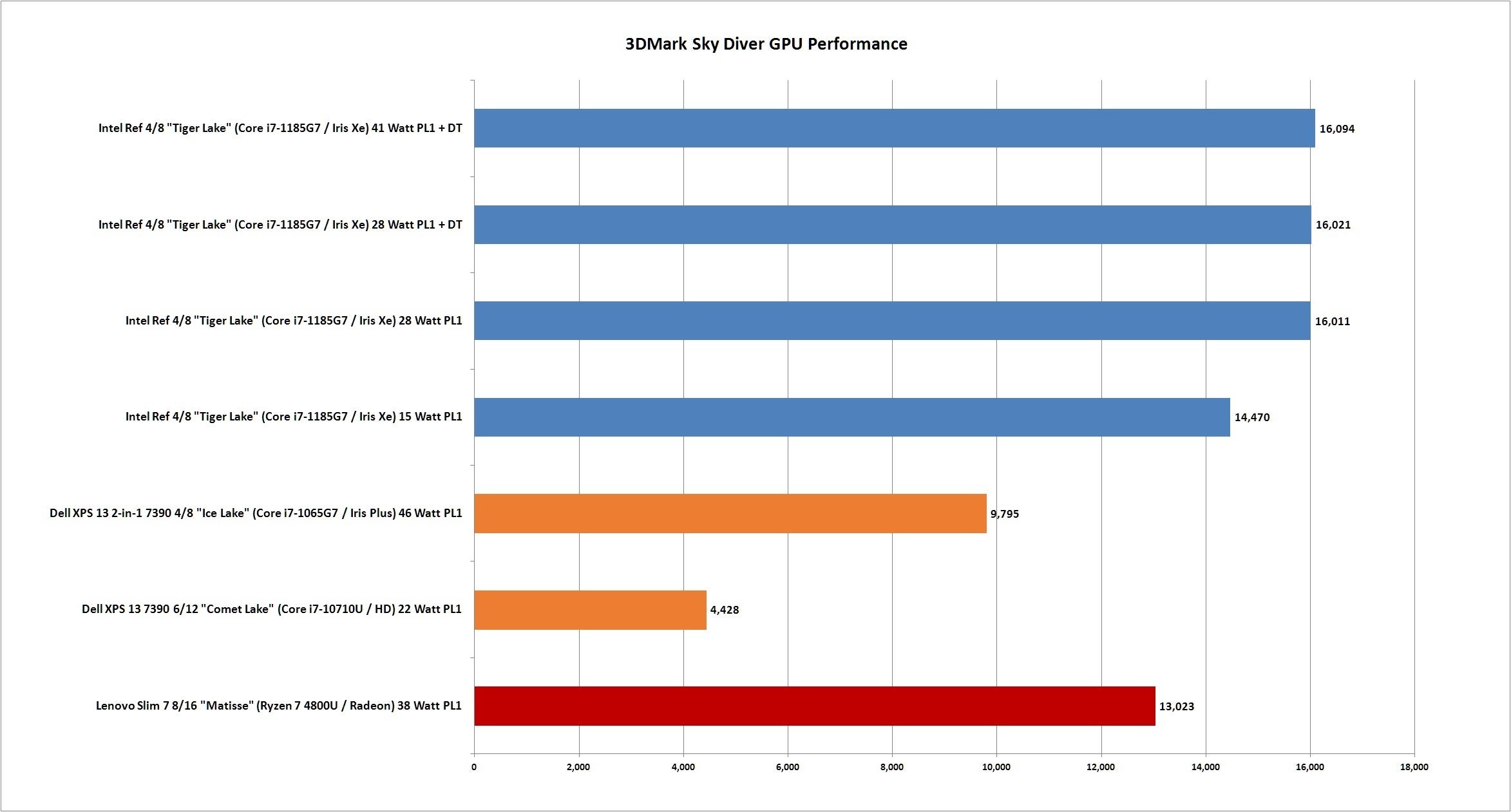 IDG
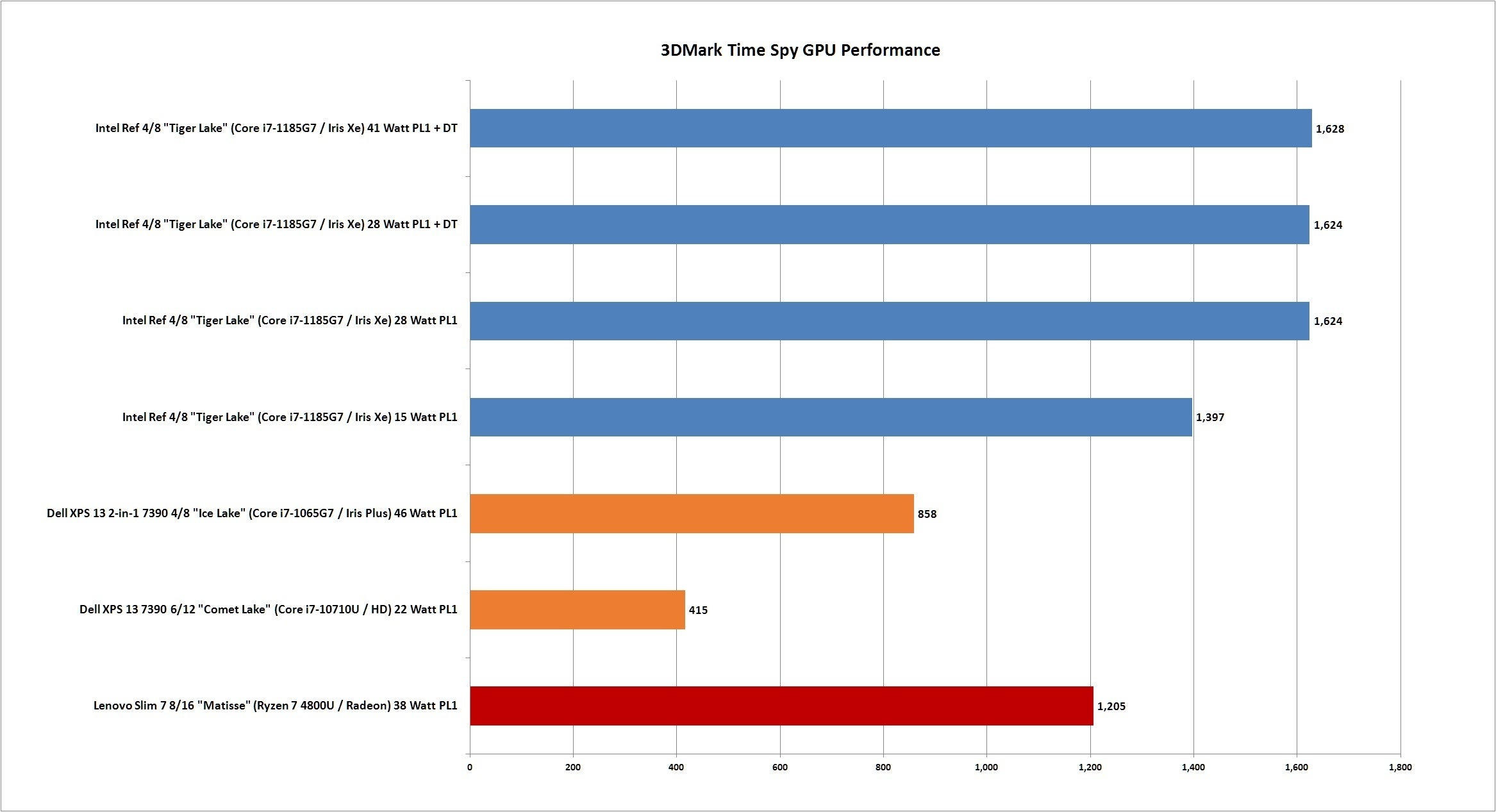
IDG3DMark’s Time Spy check is a bit more strenuous. It’s a DX12 check that UL stated truly hundreds up a GPU 5 occasions greater than 3DMark’s FireStrike. What’s superb is the outcomes virtually look the identical as Sky Diver.
With 11th-gen Tiger Lake set to its larger wattage, it’s virtually 300 % sooner than the traditional Intel HD graphics within the 10th-gen Comet Lake U chip, and about 90 % sooner than the 10th-gen Ice Lake U chip. Extra importantly for Intel is its place forward of Ryzen 7 4800U. Even with its Eight CU’s of Radeon graphics cores and LPDDR4X/4266 contained in the AMD laptop computer, the Core i7-1185G7 continues to be a wholesome 35 % sooner than its nemesis.
 IDG
IDGWe might present you outcomes from different 3DMark assessments, however we’ve had sufficient of the synthetics. And fairly than use video games you’d usually run on laptops with built-in graphics, reminiscent of Rocket League or different eSports titles, we reached for video games a bit harsher.
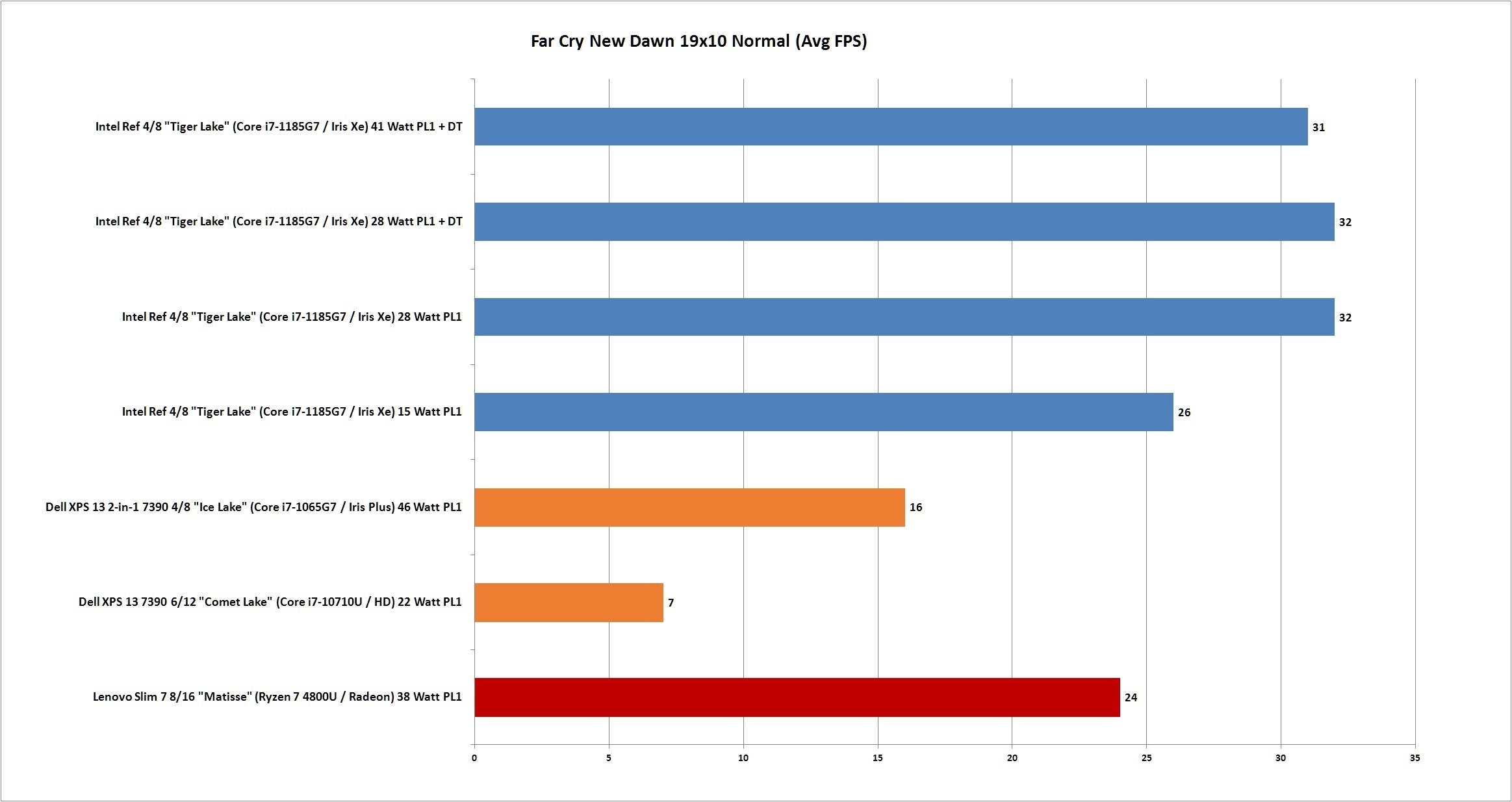
The primary is Far Cry New Daybreak, which we ran at 1920×1080 decision with the sport set to Regular. The efficiency is once more spectacular for Intel’s Iris Xe: It is available in 360 % sooner than Intel HD, 100 % sooner than Ice Lake’s Iris Plus, and 33 % sooner than Ryzen 7 4800U’s Radeon.
 IDG
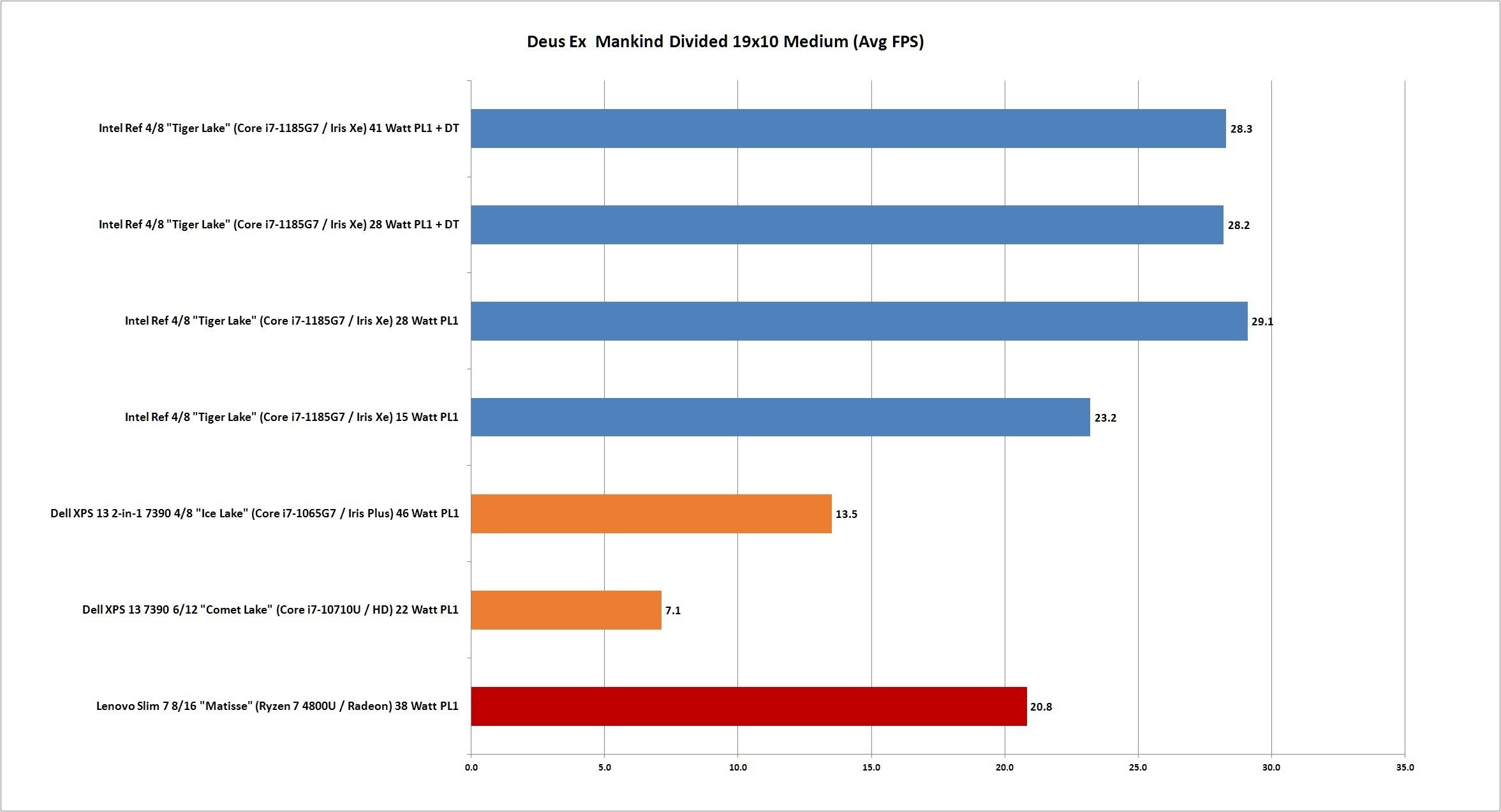
IDGThe Far Cry sequence has usually been slower on Ryzen desktop CPUs, so we additionally checked out efficiency on a sport friendlier to AMD: Deus Ex Mankind Divided. This sport was one the primary that was patched and really useful by AMD within the rollout of the unique Ryzen desktop chip.
For this showdown, we run Deus Ex at 1920×1080 with the sport at its medium preset. The Tiger Lake result’s about 300 % extra efficiency than Intel HD, 109 % sooner than 10th-gen Ice Lake’s Iris Plus, and about 36 % sooner than Ryzen 7 4800U.
 IDG
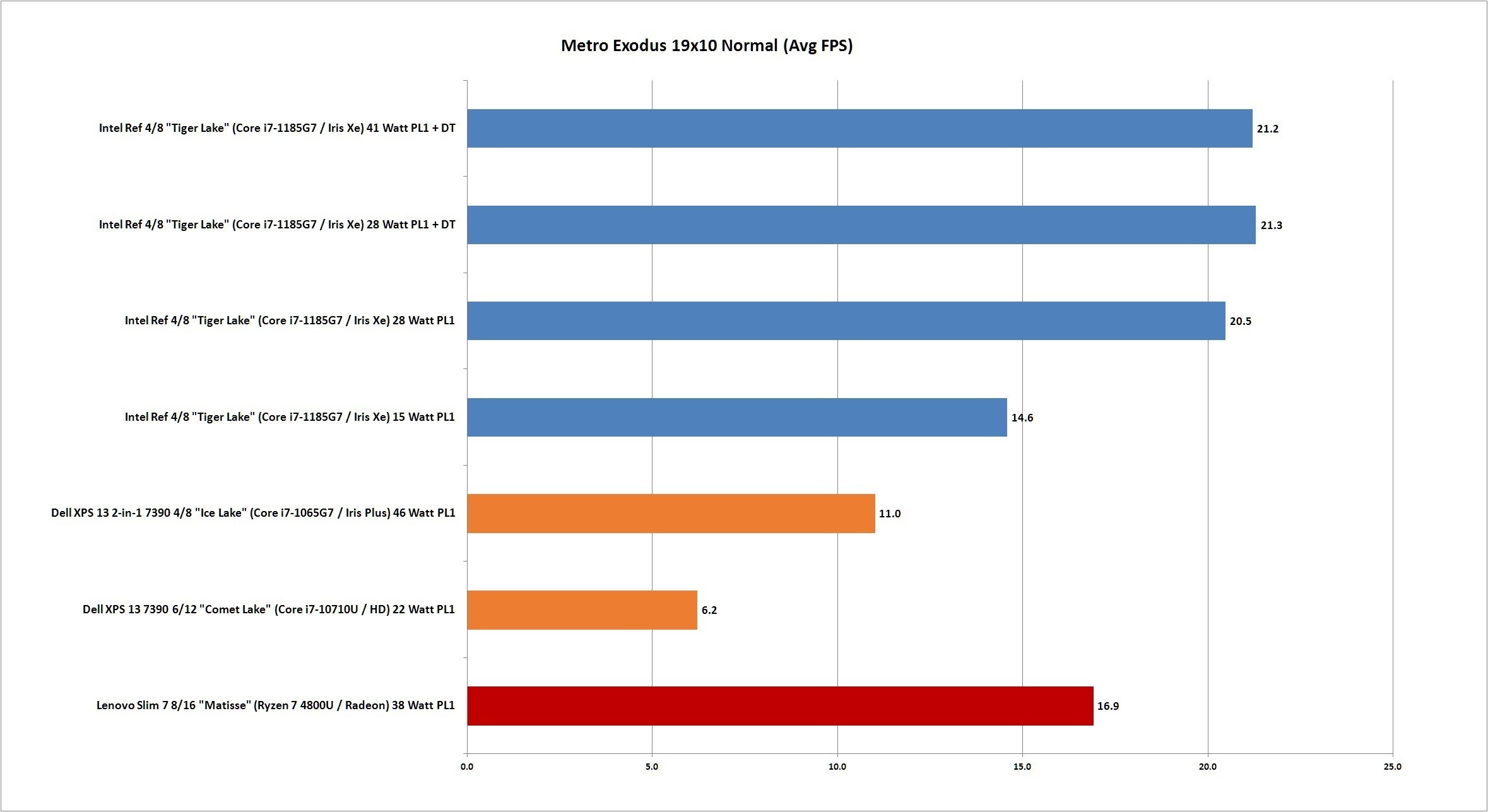
IDGTransferring to Metro Exodus at 1920×1080 with the conventional preset, we discover the 11th-gen Core i71185G7 and its Iris Xe graphics about 244 % sooner than Intel HD, about 93 % sooner than 10th-gen Ice Lake Iris Plus and 26 % sooner than Ryzen 7 4800U.
 IDG
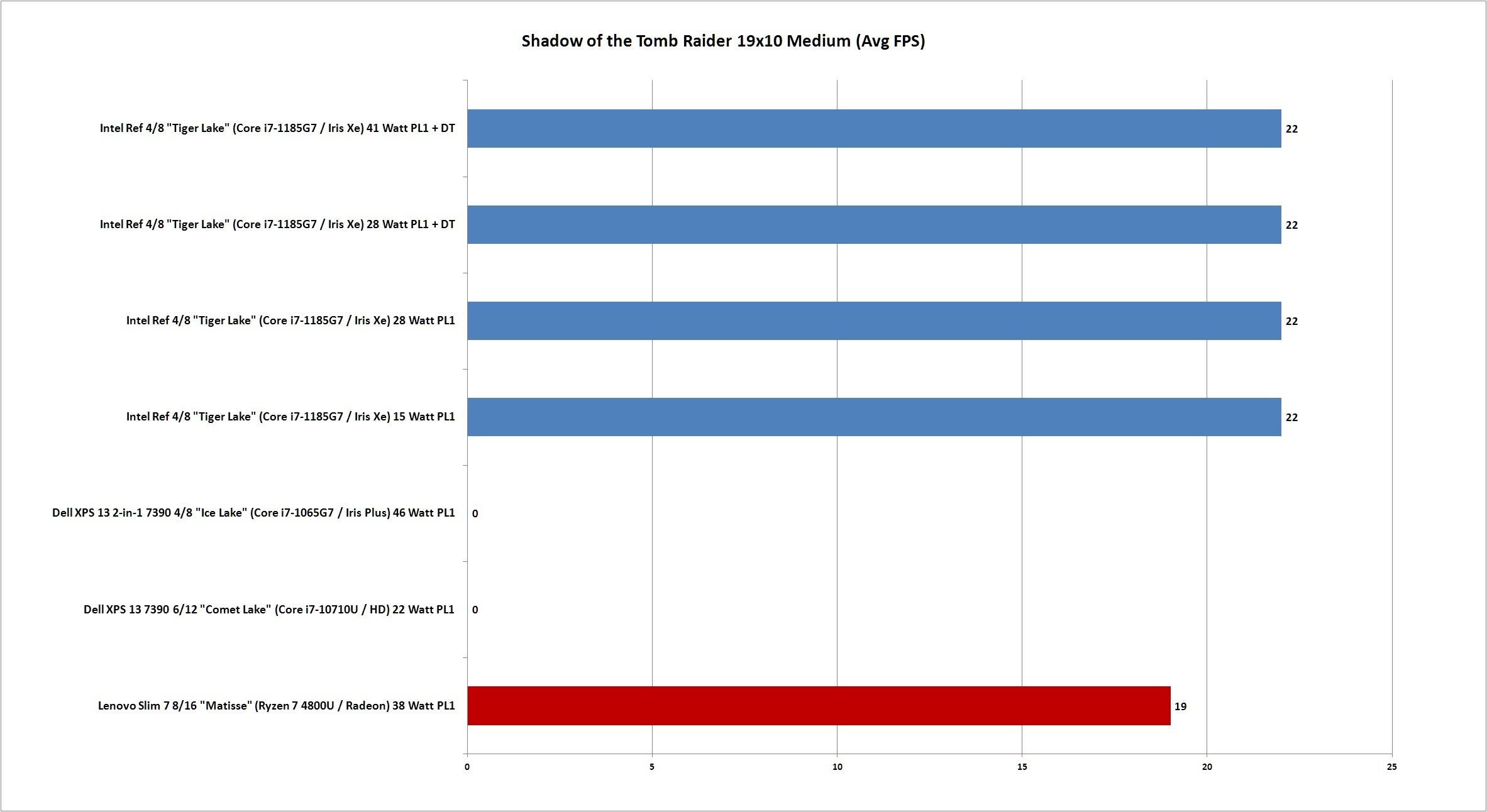
IDGThe final sport we’ll present you is Shadows of the Tomb Raider, additionally set to 1920×1080 and Medium. The sport is fairly powerful on the laptops—each the 10th-gen Core i7-1065G7 and 10th-gen Core i7-10710U failed to finish operating the benchmark. Ryzen 7 4800U did handle to shut up with the Core i7-1165G7, however it nonetheless sees the Iris Xe about 16 % sooner within the run. Winner: Tiger Lake.
 IDG
IDGIn no sport did we see the 11th-gen Tiger Lake and Xe chip lose. We additionally tried Purple Lifeless Redemption 2, the place, because of Tiger Lake’s immature drivers, the sport crashed throughout the benchmark. That in all probability sounds dangerous, however Intel stated it is aware of concerning the difficulty and can quickly deploy a brand new driver to appropriate it. For what it’s price, the Ryzen 7 4800U gave us about Eight.5 fps in RDR2, whereas to my eye, the benchmark run on Xe seemed far smoother—we’d guess within the mid- to excessive teenagers in efficiency.
Sure, none of those are a GeForce RTX 3090—however the truth that you’ll be able to even entertain enjoying barely older AAA video games on a laptop computer with Intel built-in graphics is remarkable. Crank down the decision and tune some sport settings, and we predict Xe might be as revolutionary in laptop computer gaming as, properly, AMD’s Ryzen chip was.
 IDG
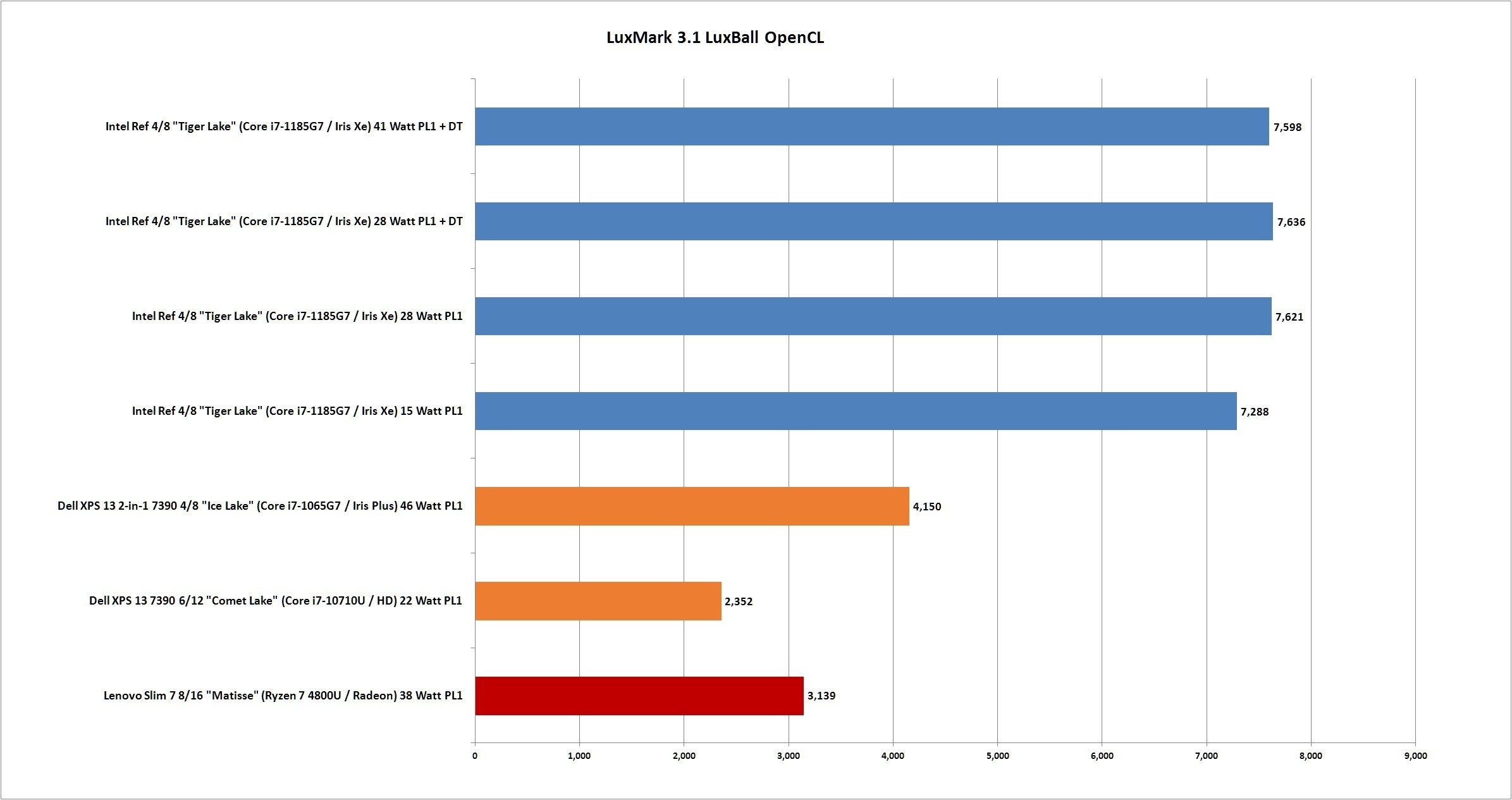
IDGThough the OpenCL graphics engine appears to be quickly shedding steam, we did wish to see the place the Xe falls, so we used LuxMark three.1 and LuxBall. It’s once more very spectacular, with Iris Xe about 225 % sooner than Intel HD graphics, 84 % sooner than Iris Plus and 143 % sooner than Radeon.
The final graphics-focused check we wished to run was the free HandBrake utility, utilizing the CPU’s Fast Sync engine. Intel stated the outcomes wouldn’t at present characterize what Tiger Lake can do. We suspect which means Tiger Lake would lose, as we’ve examined AMD’s VCE towards Ice Lake’s Fast Sync efficiency and Ryzen was barely sooner. Nonetheless, there’s not a lot of some extent proper now.
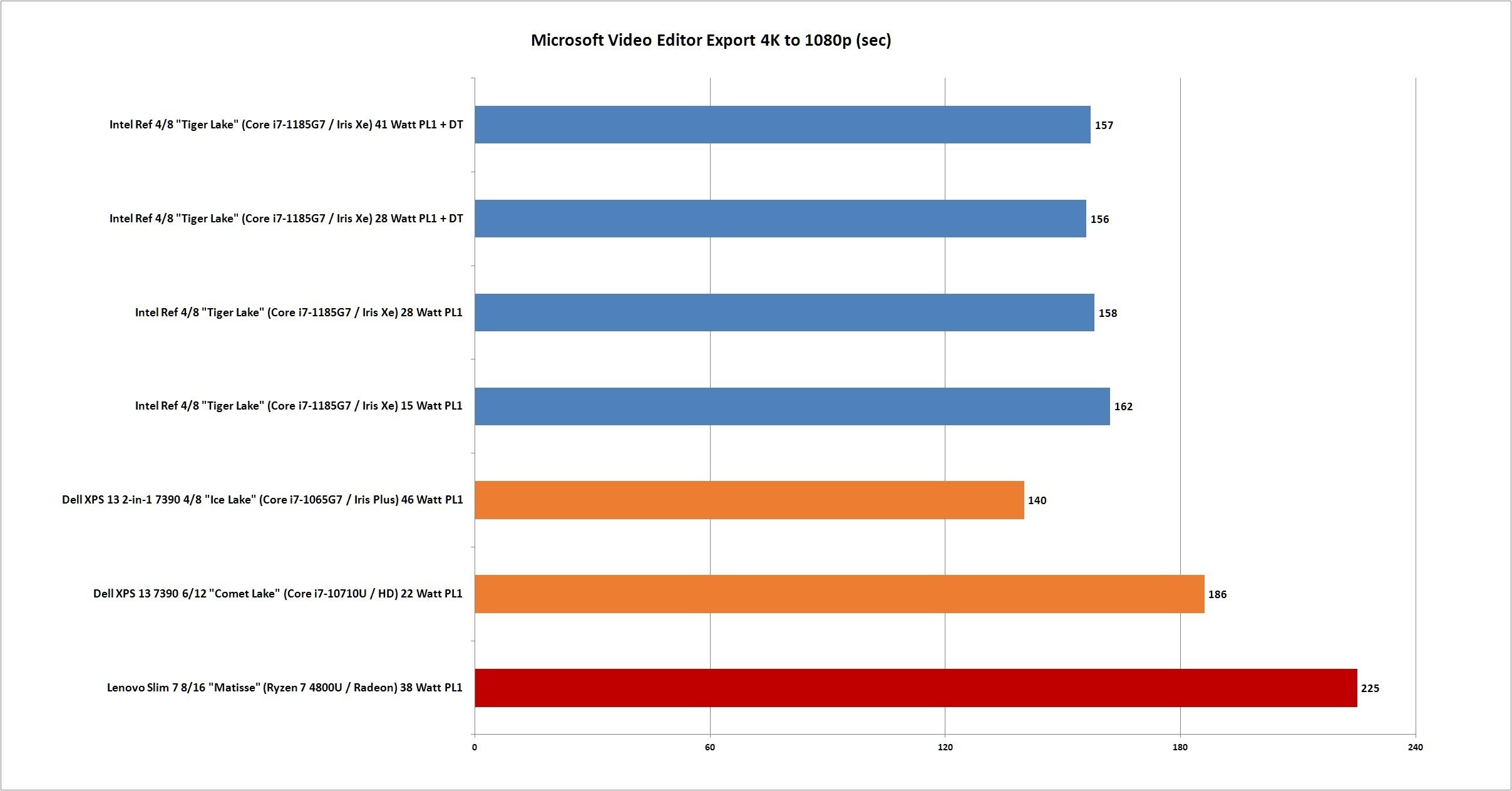
We’ll shut out with one superior media engine check: Microsoft’s free Video Editor constructed into Home windows 10, which leverages each Fast Sync and VCE. We had beforehand tried to make use of it when Ryzen first got here out, however the hardware acceleration didn’t work on AMD CPUs. AMD has since labored with Microsoft to repair it. For this easy check, we take the Tears of Metal 4K video, throw on a sepia filter, and export it to 1080p with hardware acceleration enabled.
Whereas all of the chips are decently quick, Ryzen truly finishes final, even shedding to the 10th-gen Comet Lake U chip. 11th-gen Tiger Lake itself is available in second place, with the 10th-gen Ice Lake crossing the end line first.
 IDG
IDGHold studying for CPU efficiency and extra.